

Evidence for land tax foreign surcharge significant contributor exemption application
These guidelines detail the evidence and documents you need when applying for an exemption from the land tax foreign surcharge for significant contributors.
Landholders undertaking commercial activities that make a significant contribution to Queensland may be eligible for an exemption from the land tax foreign surcharge (LTFS) for liabilities arising on or after 30 June 2026.
A separate exemption from LTFS is available for large developers undertaking residential land development.
The public ruling on the significant contributor exemption (LTA000.6) sets out the administrative arrangement, including an explanation of terminology and requirements. The information and examples below are the Commissioner of State Revenue’s guidelines on the general information you need when applying for the exemption.
- These guidelines provide general information and do not override the ruling.
- Each application is considered on a case-by-case basis.
- An incomplete application may cause delays in determining your eligibility for the exemption.
- Where possible, we’ll use the information we have but may request additional information from you.
Eligibility
We will generally consider the facts and circumstances as at the date of liability for LTFS (being 30 June each year for the following financial year) as well as the 12 months before the liability date of the financial year for which the entity is seeking the exemption. For instance, if the entity is seeking an exemption for the 2026–27 financial year, you need to provide information and evidence regarding the facts and circumstances from 1 July 2025 to 30 June 2026 (i.e. land owned by the entity as of 30 June 2026). There may be exceptions to this, such as when averaging or committed future commercial activities may apply.
You need to provide evidence that you have satisfied certain conditions.
You must prove that you meet:
- Australian-based requirements
- Foreign Investment Review Board (FIRB) requirements
- regulatory requirements
- significant contribution requirements
- size and scale of commercial activities.
General requirements
See the public ruling (LTA000.6) for the full list of defined terms.
An entity is an individual or company registered under the Corporations Act 2001 (Cwlth).
For the LTFS exemption, the applicant would be a landowner that is considered a foreign company or a trustee of a foreign trust for land tax purposes.
Where a landowner is a trustee acting in a nominee or custodian capacity for regulatory compliance purposes, the nominee or custodian will be looked through and eligibility for the exemption will be determined by reference to the activities of the next-level trustee.
Corporate group tracing is available for most of the eligibility requirements in the ruling.
- A parent entity is an entity that directly owns at least 90% of the issued shares in and has voting control over another entity.
- A subsidiary entity (first entity) is one in which another entity directly owns at least 90% of issued shares and has voting control over the first entity.
- Voting control means that an entity is in a position to cast, or control the casting of, 90% or more of the maximum votes that can be cast at a general meeting of a company (other than under a debenture or trust deed securing the issue of a debenture).
- All parent and subsidiary entities constitute a corporate group.
- Each entity within the corporate group is a group entity.
Example: Contributions not considered
XYZ Pty Ltd is holding land in Queensland in its capacity as a trustee of a trust. The beneficiaries of the trust are 3 unit holders, each one a corporation that operates independently of each other.
Two of the unit holders have entered into commercial agreements on behalf of all unit holders with a third party, LTF Pty Ltd, to use the land for property development purposes in the relevant period. LTF’s employees oversee the property development activities on the land, including engaging with contractors and suppliers.
As part of its application for a large developer exemption, XYZ submits that LTF’s development activities satisfy the large developer requirements under the ruling.
However, these are not activities of the landholding entity, XYZ. No other entity owns at least 90% of the shares in XYZ and XYZ does not have any subsidiaries. As a result, XYZ cannot rely on any eligible parent or subsidiary to satisfy the large developer requirement. Only the activities of an entity that is directly connected to XYZ by way of at least 90% share-ownership and voting control can be considered.
The circumstances and activities of a group entity can be taken into account when considering whether relevant requirements are satisfied. Where this happens, the entity is referred to as a ‘relevant group entity’.
Supporting documentation includes:
- a corporate structure diagram of the corporate group confined to entities that are directly connected by at least 90% share-ownership and voting control (including identifying the entity seeking the exemption and the other group entities)
- ASIC records confirming the entity’s connection with the parent entity that directly owns at least 90% of shares in it and any other entity on being relied on via corporate group tracing, in the 12 months before the liability date.
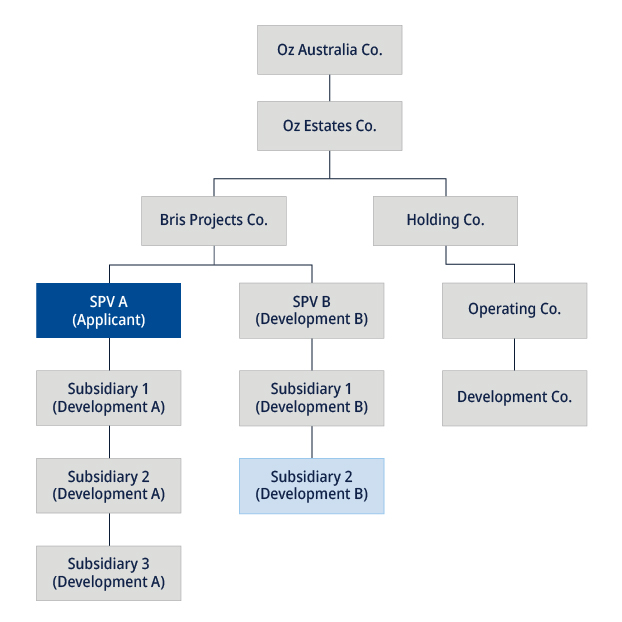
Example: Corporate group connected by 90% or more shareholding and voting control
SPV A has applied for an LTFS exemption for land it owns as at 30 June 2026 (the liability date). It does not meet the Australian-based requirements at the liability date, except for having an Australian head office and Australian principal place of business.
However, Subsidiary 2 (Development B) has provided information to confirm that it is connected to SPV A through the other entities in the corporate group by way of 90% or more shareholding and voting control at the liability date. That is, as defined under the ruling:
- SPV A is the subsidiary of Bris Projects Co.; and Bris Projects Co. is a parent of SPV A.
- Bris Projects Co. is the parent of SPV B; and SPV B is a subsidiary of Bris Projects Co.
- SPV B is a parent of Subsidiary 1 (Development B); and Subsidiary 1 (Development B) is a subsidiary of SPV B.
- Subsidiary 1 (Development B) is a parent of Subsidiary 2 (Development B); and Subsidiary 2 (Development B) is a subsidiary of Subsidiary 1 (Development B).
- SPV A, Bris Projects Co., SPV B, Subsidiary 1 (Development B) and Subsidiary 2 (Development B) are a relevant corporate group at the liability date.
Subsidiary 2 (Development B) has also provided information to confirm that it meets the Australian-based requirements as at the liability date. On this basis, the Australian-based requirements for SPV A’s exemption application are met.
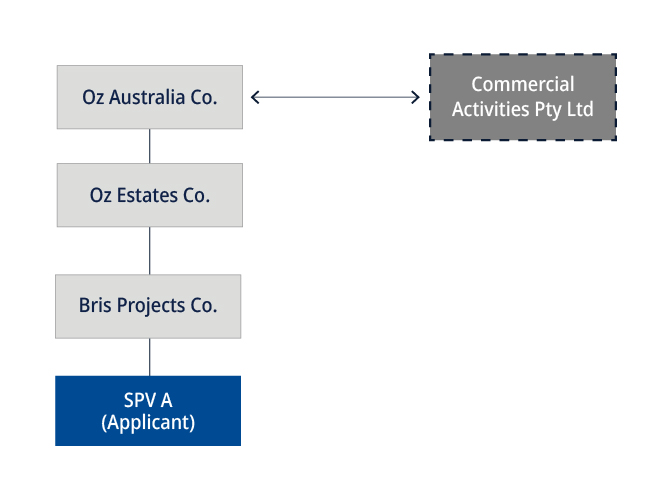
Example: Use of contractors to undertake commercial activities as a significant contribution
SPV A is the landholding entity and applicant. It is not undertaking any commercial activities in its own right, but is holding the land passively.
Under the ruling:
- Oz Australia Co. is a parent of Oz Estates Co.; and Oz Estates Co. is a subsidiary.
- Oz Estates Co. is a parent of Bris Projects Co.; and Bris Projects Co. is a subsidiary.
- Bris Projects Co. is a parent of SPV A; and SPV A is a subsidiary.
- These entities constitute a relevant corporate group.
- Oz Australia Co. engages Commercial Activities Pty Ltd to undertake commercial activities on SPV A’s land. Commercial Activities employs 250 full-time equivalent (FTE) employees in Queensland during the relevant period.
- Commercial Activities is not part of the relevant corporate group. It is neither a parent nor a subsidiary of Oz Australia Co., Oz Estates Co., Bris Projects Co. or SPV A.
- Given that Commercial Activities is not part of the relevant corporate group, its employment of 250 Queensland FTE employees in the relevant period cannot be counted.
Once an exemption from LTFS is approved, it applies to all of the entity’s taxable land in Queensland in respect of the financial year for which the exemption is sought. However, the exemption can continue to apply for subsequent financial years without the entity having to lodge a new application each year, provided certain conditions are met. For this to happen, the entity must lodge—at the beginning of each financial year—a statutory declaration confirming that no notifiable events have occurred and that the entity will remain eligible for the exemption.
See the public ruling (LTA000.6) for the definition of ‘notifiable event’.
If the entity has been pre-approved or approved for an exemption and a notifiable event occurs, the entity must notify us of the event within 28 days after the event happens.
We have used future dates in these examples.
Example: Corporate group changes before liability arises
GFL Pty Ltd received pre-approval on 30 September 2026. Pre-approval was sought on 10 September 2026 for land GFL expects to hold on 30 June 2027.
GFL received pre-approval on the basis that a group entity, JJJ Pty Ltd, had been approved for the LTFS exemption previously under the ruling. The evidence confirmed that JJJ was GFL’s parent at the time pre-approval was sought, owning 95% of the shares as well as 95% voting control in GFL.
On 1 January 2027, JJJ disposed of all of its shares and voting control in GFL. This means that JJJ is no longer a group entity.
Consequently, GFL is required to notify the Commissioner of this change in the approved form. Further, GFL may need to apply for pre-approval on a different basis or apply for the LTFS exemption without pre-approval when the liability for the LTFS arises on 30 June 2027.
Example: Non-compliance with regulatory requirements arose after exemption applied
DDD Pty Ltd received the LTFS exemption for land it owned on 30 June 2027. As part of its application for the exemption, DDD demonstrated that it expended $25 million on Queensland goods and services from 1 July 2026 to 30 June 2027.
After the exemption was approved, an investigation found that DDD had underpaid payroll tax across multiple financial years, resulting in reassessments including penalty tax and interest.
Consequently, DDD is required to notify the Commissioner of this change in the approved form. Further, DDD may need to repay the amount of LTFS exemption received.
Example: Corporate group changes after exemption received but before significant contributions have been satisfied
BBB Pty Ltd received the LTFS exemption for land it owned on 30 June 2027. As part of its application for the exemption, BBB submitted that its group entity, CCC Pty Ltd, would make a significant contribution on the land from 1 July 2027 and 30 June 2028 by employing 80 full-time equivalent employees during this time.
In obtaining the LTFS exemption, it was confirmed that BBB was CCC’s parent in the 12-month period leading up to—and on—30 June 2027, on the basis that BBB owned 95% of the shares as well as 95% voting control in CCC.
On 1 September 2027, BBB disposed of all of its shares and voting control in CCC. This means that CCC is no longer a group entity. This also means that CCC’s contributions cannot be counted for the 12-month period from the liability date.
Consequently, BBB is required to notify the Commissioner of this change in the approved form. Further, unless any other significant contributions exist that can be counted, BBB is likely to need to repay the amount of LTFS exemption received.
An entity can apply for pre-approval of the significant contributor exemption for a financial year if one of the following applies.
- The entity has previously been approved or pre-approved for the significant contributor exemption or LTFS ex gratia relief.
- A group entity in a corporate group has been approved for the significant contributor exemption, while a member of the group, and the entity is the parent or a subsidiary of a group entity when the liability for land tax arises.
If pre-approval is given, it will continue to apply until a notifiable event occurs.
- Prior pre-approval or approval. An entity is not eligible for the significant contributor exemption if it has been pre-approved or approved for the large developer exemption.
- Approval of build-to-rent (BTR) concession. An entity is not eligible for the significant contributor exemption if a concession from LTFS for an eligible BTR development has been applied to its land.
Australian-based requirements
Generally, evidence includes:
- details of a current ACN, ABN, Australian Registered Body Number (ARBN) or ASX listing and public details from other Australian regulators
- prospectus documents
- minutes of meetings
- corporate memoranda
- payroll data
- contracts
- quotes or invoices for Australian contractors and suppliers.
Depending on the specific requirement and facts and circumstances of your application, additional information should be provided.
Provide an ASIC historical extract showing the entity’s principal place of business and a copy of the entity’s lease or title documents showing the location of the head office or the principal place of business.
Generally, we do not accept an accountant, solicitor or agent’s office address as evidence of the entity’s head office or principal place of business.
If the address listed on ASIC is leased or owned by another entity, advise of the relationship between the entities.
Corporate group tracing is not available for this requirement.
Example: Entity does not have a principal place of business in Australia
XYZ Pty Ltd is seeking an exemption and has provided evidence by way of an ASIC search that its principal place of business is in Australia. The address listed on ASIC is owned by another entity who XYZ has stated is its accountant. XYZ has no other head office or principal place of business address for its business in Australia and has not provided any other evidence to prove that it has another address in Australia.
Because of this, XYZ has not established that it satisfies this requirement.
You’ll need to provide evidence of significant Australian management staff and office presence.
Significant management staff
Significant management staff (i.e. directors and managers) in Australia must be employed by the entity, or by a relevant group entity where corporate group tracing applies. The employment arrangements must exist at the time that liability arises.
- Entity directly employs significant management staff—evidence includes:
- a diagram of the entity’s organisational structure outlining the entity’s management staff in Australia
- information outlining how the management staff is engaged and the types of management functions they undertake in relation to the entity’s commercial activities
- evidence that the management staff is Australian based, such as an ASIC extract or corporate documents
- corporate documents, such as
- any relevant management or service agreements
- prospectus, project documents, brochures or annual reports that outline the entity’s presence in Australia.
- Relevant group entity in a relevant corporate group employs significant management staff—evidence includes:
- the name and ABN of this entity
- the entity’s ASIC historical extract
- a corporate structure diagram of the corporate group confined to group entities (including identifying the entity seeking the exemption and the employing relevant group entity)
- information confirming that these connections and arrangements occurred in the relevant period
- employment details and employment evidence such as examples of contracts, which confirm the arrangements and the periods in which they were entered into and operated for. (See ‘Employs Australian citizens or permanent residents’ for more detail.)
Significant office presence
Provide evidence the entity has significant office presence in Australia including:
- the number of offices located in Australia
- the functions and activities being undertaken in the offices
- how those functions and activities relate to the entity’s commercial activities in Australia.
If the entity’s principal place of business address recorded with ASIC or other offices are leased or owned by another entity, also provide the details of the relationship between the entities.
If the address belongs to entity’s solicitor or accountant for instance—and the entity does not have any other location for its business—it will likely not be considered to have a significant office presence in Australia unless alternative evidence to this effect can be provided.
Example A: The other entity is not a group
XYZ Pty Ltd is seeking an exemption and has only provided general statements that indicate that JFL Pty Ltd is providing management services for XYZ’s commercial activities in Australia.
We request evidence supporting the connection between XYZ and JFL.
XYZ responds with:
- ASIC records as well as other ASIC records for the relevant corporate group
- copies of a management agreement between XYZ and JFL
- information advising that the entities are part of the same corporate group (the ASIC record supplied indicates that JFL owns 60% of the shares in XYZ’s parent).
XYZ’s parent directly owns at least 90% of the shares and has voting control in XYZ. But JFL does not directly own at least 90% of the shares in XYZ’s parent and does not have voting control in XYZ.
The management services JFL is providing XYZ cannot be considered when determining if this factor has been met, regardless of the presence of the management agreement.
Example B: The other entity is not a group
DOF Pty Ltd is seeking an exemption and has only provided general statements about how it meets the significant management staff and office presence in Australia factor.
After an information request, DOF advises:
- It is connected to an entity called RLB Pty Ltd through a common director.
- RLB has engaged an unrelated management services business called YRW Pty Ltd.
- YRW is providing the management services in relation to the commercial activities on DOF’s land.
DOF also confirms that it does not employ directly. Its director—who is not an employee—provides some strategic oversight of DOF’s commercial affairs.
The connection between DOF and RLB is unable to be considered, because they are not group entities. Therefore, RLB’s arrangements—including its engagement with YRW—is unable to be considered towards DOF’s satisfaction of this factor.
Although DOF has a common director that may provide strategic oversight of the commercial activities on its land, it does not employ significant management staff directly, including their director.
Entity as employer—evidence includes:
- payroll data that identifies the total number of employees based in Australia and the number that are Australian citizens or permanent residents
- an employee register showing the residence of the employees and whether they are Australian citizens or permanent residents
- financial statements, such as profit and loss statements, confirming employee expenses
- a sample of employment contracts between the entity and its employees, as well as information confirming that the employees are Australian citizens or permanent residents.
Group entity as employer—evidence includes:
- the name and ABN of the employing entity
- the employing entity’s current ASIC historical extract
- a corporate structure diagram of the relevant corporate group that identifies the entity seeking the exemption and the employing entity
- information confirming that these connections and arrangements occurred in the 12 months prior to, and including, the liability date.
We have used future dates in this example.
Example: Satisfies this factor with group entity
XYZ Pty Ltd is a property development company and is seeking an exemption for the 2026–27 land tax year.
XYZ provides evidence confirming that:
- the employing entity in the relevant corporate group is DEF Pty Ltd
- DEF wholly and directly owns the shares in XYZ between 1 July 2025 and 30 June 2026
- DEF’s employees are Australian citizens.
XYZ would be considered to have satisfied this requirement because DEF can satisfy this requirement.
Entity carries on business in Australia—evidence includes:
- a list of business activities conducted in Australia in the last 5 years and evidence of this business activity
- evidence of expenditure on business activities such as invoices from third parties relating to the supply of goods or services in the relevant period
- financial or corporate documents, such as
-
- annual reports
- profit and loss statements
- wage or salary expenditure
- strategic plans
- incurred and forecast expenditure
- other corporate documents outlining the above.
-
Group entity in the relevant corporate group carries on business in Australia—evidence includes:
- the name and ABN of this entity
- this entity’s current ASIC historical extract
- a corporate structure diagram of the relevant corporate group confined to group entities (including identifying the entity seeking the exemption and the entity carrying on the business)
- ASIC historical extracts of all group entities that traces the entity seeking the exemption to this entity via corporate group tracing
- information confirming that these connections and arrangements occurred in the 12 months before the liability date.
‘Primarily’ means chiefly or principally. Where decisions are made by multiple entities across different jurisdictions, an assessment must be made as to whether those decisions that are made by management or employees in Australia are the primary decisions about the entity’s business and operations in Australia. Generally, where more than 50% of decisions are made by management or employees in Australia, this would prima facie suggest that the requirement is satisfied. However, this is not an absolute rule; and the assessment must be made on a case-by-case basis.
Entity
To prove the entity’s management or employees in Australia primarily make decisions about the entity’s business and operations in Australia, include:
- memoranda executed by or on behalf of the entity, stating the powers of the entity’s directors, managers and key personnel in relation to Australian participation
- organisational structure identifying location and responsibilities of staff involved in making strategic or key operational decisions
- copies of minutes of meetings conducted in Australia that show Australian decision making in the 12 months before the liability date. (The meeting minutes must confirm the names of the people in attendance and the decisions being made by those people.)
Group entity
To prove the management or employees of a group entity primarily makes decisions about the entity’s business and operations in Australia, include:
- the name and ABN of this entity
- this entity’s current ASIC historical extract
- a corporate structure diagram of the relevant corporate group confined to group entities (including identifying the entity seeking the exemption and the entity that conducts its commercial activities in Australia and primarily makes decisions about the entity’s business and operations in Australia)
- ASIC historical extracts of all group entities that trace the entity seeking the exemption to the relevant group entity via corporate group tracing
- information confirming that these connections and arrangements occurred in the 12 months prior to, and including, the liability date.
We have used future dates in this example.
Example: Unlikely to satisfy this factor
XYZ Pty Ltd is seeking an exemption for the 2026–27 land tax year.
It has stated that all important operational decisions are made by their chief financial controller, Mr Diamond. XYZ has provided evidence that confirms that Mr Diamond’s authority level to approve decisions is limited to administrative costs of no more than $10,000.
Other information provided by XYZ suggests that it is entering into multiple contracts with unrelated third parties for its retail business that are valued at greater than $5 million in 2025–26 financial year.
Without further information or evidence, it is likely that Mr Diamond’s authority may not be sufficient for it to be considered that decisions about XYZ’s business and operations in Australia are primarily made by XYZ’s management and employees.
XYZ should provide information about other arrangements it may be undertaking to satisfy this factor.
FIRB requirements
Where possible, we will attempt to assess whether Foreign Investment Review Board (FIRB) requirements have been met by the information already available to us. If this is not possible, we will request supporting documentation.
You can provide relevant supporting documentation when lodging your exemption application; for example:
- where approval was required, a copy of the entity’s FIRB approval or no objection document
- where approval was not required, the reasons why and any information from FIRB from the time of acquisition supporting these reasons
- where approval has not yet been received, a copy of the FIRB application (together with supporting documents)
- copies of any other correspondence with FIRB concerning the entity’s compliance
- details regarding how any previous non-compliance issues have been addressed.
Example: Insufficient information to satisfy this factor
In its application for an exemption, XYZ Pty Ltd advises that it does not know if it obtained (or was required to obtain) FIRB approval because the acquisition of the land was historic and internal records are not on file.
We do not have access to relevant documentation confirming the entity’s FIRB status. We issue an information request to XYZ to provide evidence of either approval from FIRB or a no objection certificate to the acquisition of the entity or the land.
Because XYZ does not have a copy of the letter or certificate available, it needs to contact FIRB to source a copy of relevant documentation.
Regulatory requirements
You will need to meet general regulatory requirements, including compliance under Queensland revenue laws.
We will assess whether legal and regulatory requirements have been met by the information already available to us. If this is not possible, we will request supporting documentation.
You can provide relevant supporting documentation when lodging your exemption application; for example:
- a written statement confirming whether regulatory requirements in Australia (if applicable) or another relevant jurisdiction (if any) have been complied with
- where the entity or the group entity is listed on a stock exchange
- the stock exchange on which it is listed
- the name it is listed under
- any unique code used to identify the entity on the exchange
- the entity and the group entity’s financial or annual reports required to be lodged with ASIC (or equivalent entity) for the last 2 years (If the entity or the group entity have been registered for less than 2 years, provide a copy of the entity’s financial report and any other reports lodged.)
- if the entity or the group entity is under the control of another entity, consolidated financial reports or annual reports of the controlling entity required to be lodged with ASIC (or equivalent entity) for the last 2 years
- if relief from lodgement of financial reports has been granted by ASIC, evidence of this
- if the entity or the group entity is not registered with ASIC, any other documents (including financial reports or annual reports) for the last 2 years that the entity and the group entity are required to prepare by the law that applies in the entity’s place of origin. (If any document is not in English, provide a certified translation of that document into English.)
If you (the entity and/or the group entity) have had previous dealings with us, we will consider whether the entity and the group entity have been subject to, or are currently dealing with, our audit or collection activity. To help with this process, you should provide relevant QRO client numbers.
If any revenue laws have not been complied with, provide confirmation that any previous non-compliance issues have been addressed.
Typically, we only consider information relating to the 12 months before the liability date; however, we may consider the entity’s and the group entity’s historical and current non-compliance.
If you have entered into a payment arrangement with us, this will not be treated as non-compliance, provided you meet your responsibilities under the arrangement.
Example: Unpaid state tax liabilities
XYZ Pty Ltd is applying for an exemption and has advised that it complies with Queensland’s revenue laws, including lodging and paying all liabilities on time.
Records indicate that XYZ has outstanding unpaid state revenue liabilities spanning multiple financial years. A further search shows that it does not have an instalment plan in place to reconcile the outstanding debt.
We may ask XYZ to explain what actions or plans it will put in place to resolve the outstanding amount.
XYZ’s response—in addition to not voluntarily disclosing the outstanding amount or taking steps to reconcile the payment—will be considered when determining if it meets this requirement.
We have used future dates in this example.
Example: Subject of audit activity
ETF Pty Ltd has applied for an exemption for the 2026–27 land tax year, which was received on 30 April 2029.
ETF submits that it has been consistently compliant with all Queensland revenue laws since it first registered for land tax on 1 January 2010. It has provided evidence that it has paid its land tax liabilities leading up to and including the 2025–26 land tax year.
Our records show that ETF has been subject to an audit relating to non-compliance for the 2027–28 financial year. This investigation determined that ETF had failed to disclose relevant landholdings for this period, which resulted in an incorrectly reduced land tax assessment. It was also found that ETF was uncooperative throughout the duration of the investigation, which contributed to the imposition of 25% penalty tax and full unpaid tax interest.
Even though this non-compliance occurred after the relevant period, it can still be considered when determining if ETF meets the regulatory requirement.
Significant contribution requirements
Whether the entity makes a significant contribution to the Queensland economy and community will depend on the extent to which the entity conducts commercial activities in Queensland, engages local labour and utilises local materials and services.
If the entity cannot satisfy this requirement, an entity that is a group entity in the relevant corporate group may be considered under corporate group tracing.
The entity makes a significant contribution if it or a relevant corporate group has:
- current commercial activities, or committed future commercial activities over a 12-month period from the liability date, at the requisite contribution level
or
- commercial activities in a non-metropolitan area and/or particular industries that the Commissioner has approved under paragraph 21 of LTA000.6 as a significant contribution (regional and/or industry significance).
Alternatively, the entity or a relevant corporate group may be treated as a significant contributor where:
- the entity or the corporate group makes a significant contribution, on average, each financial year provided the averaging does not exceed 5 consecutive financial years (averaging period)
or
- the entity’s commercial activities or those of the corporate group are approved by the Commissioner as having regional and/or industry significance.
In the 12 months before the liability date—or as part of committed future commercial activities over a 12-month period from the liability date—the entity must be:
- employing 75 or more full-time equivalent employees (not labour hire or contractors) in Queensland
or
- incurring expenditure in Queensland of more than $20 million annually; comprising Queensland payroll tax and land tax liabilities, expenditure on Queensland goods and services, and wages paid to Queensland residents.
The local workers engaged must be employees (not labour hire or contractors) in Queensland. The number of workers is to be counted in terms of full-time equivalents (FTEs). If an entity or a relevant corporate group do not employ workers directly, this requirement will not be satisfied.
Evidence includes:
- payroll data (including the total number of employees based in Australia and the number of employees engaged in Queensland)
- evidence of number of employees
- payroll summary outlining the list of employees and their employment status (such as full time, part time or casual)
- a sample of employment contracts confirming the employment of the Queensland FTE in the period under consideration.
You must provide evidence that more than $20 million has been expended on Queensland resources by the entity or a relevant corporate group in the 12 months before the liability date (unless averaging or committed future commercial activities apply).
The expenditure that can be included is ongoing; we will generally not accept one-off payments when considering if the entity satisfies this requirement. Further, evidence must specifically relate to the entity’s contributions or that of a group entity if relying on corporate group tracing to meet this requirement.
- Expenditure that can be considered as ongoing expenditure on Queensland resources:
- wages
- goods and services
- state taxes such as payroll tax and land tax
- Expenditure that cannot be considered:
- capital expenditure (including renovation and maintaining an asset)
- transfer duty payments
- finance and borrowing costs incurred in holding an asset
- Evidence to be provided:
- details of the dollar value spent on contracts for materials and services with Queensland contractors and suppliers
- details about the nature of the expenditure (operational, capital and how it contributes to the Queensland economy), and the period which the expenditure relates
- details as to whether the expenditure primarily relates to the entity’s business
- details regarding the entity’s role in the expenditure, such as whether
- the entity, or a group entity, directly engages the supplier or directly acquires the goods to which the expenditure relates
- if the entity (or a group entity) engages an intermediary, and the intermediary engages a supplier or acquires the goods. If this is the case, provide details regarding the intermediary and its relationship to the applicant
- copies of
- contracts
- quotes
- invoices for materials or services with Queensland suppliers, which confirm the client and the supplier and an invoice date
- information confirming that your tax liabilities for payroll tax and land tax (if applicable) have been paid
- details of Queensland contractor and supplier expenditure incurred in Queensland
- audited financial statements or annual reports (including profit and loss statements, balance sheets and statements of cashflows) outlining expenditure that can be identified as project-specific or Queensland-specific
- payroll data that includes the total wages paid to Queensland residents
We have used future dates in these examples.
Example: Capital expenditure not considered
XYZ Pty Ltd, a grain harvesting business, has applied for an exemption for the liability as at 30 June 2026 for the 2026–27 land tax year.
It has provided financial statements—including a balance sheet and a profit and loss statement for the 2025–26 financial year—as evidence that it has expended more than $50 million in the 12 months before the liability date. It also provided contracts it has with various Queensland suppliers.
We identify that the advised expenditure aligns to that of a capital improvement valued at $50 million that XYZ made to its grain storage sheds located across all of its landholdings in Queensland.
The profit and loss statement indicates that XYZ does not recognise these amounts as expenditure. The balance sheet confirms that these amounts were capitalised. This was reflected by an increase to the property, plant and equipment accounts and is being depreciated.
Given that the $50 million XYZ incurred for these costs is likely to be capital expenditure it is unlikely that these amounts will be considered for the purposes of this factor.
Example: Expenditure not incurred directly by the entity seeking the exemption
ABC Pty Ltd, a mine operator, has applied for an exemption for the 2026–27 land tax year.
As part of its application, it submitted copies of its 2023–24, 2024–25 and 2025–26 annual reports as well as copies of relevant contracts for local services and materials. The profit and loss statement showed operating expenses of $3 million for 2023–24, $4 million for 2024–25 and $3.75 million for 2025–26. No other operating expenses were recognised in the relevant periods.
Although the provided contracts showed expenditure of over $20 million, our review confirmed that contracts were entered into by BCD Pty Ltd—a separate related entity that is a group entity under the ruling.
Given that ABC did not directly expend more than $20 million on local services and materials, it is unlikely that it will be considered sufficient for the purposes of this requirement.
Our review of ABC’s corporate structure confirms that BCD is directly and wholly owned and controlled by ABC (i.e. BCD is a relevant group entity, and functions as the main operating entity for the mine). Even though ABC is unable to satisfy this factor in its own right, we are able to consider BCD’s expenditure of more than $20 million in relation to the mine.
Example: Entity’s own expenditure for relevant period
XYZ Pty Ltd is seeking an exemption for the 2026–27 land tax year and has provided consolidated financial statements for itself as well as 3 other entities that cover activities in the 2023–24 financial year.
XYZ needs to confirm its specific expenditure, given that the consolidated financial statements include activities undertaken by other entities that are not group entities rather than exclusively covering activities undertaken by XYZ.
The financial statements provided relate to the 2024–25 financial year. For entities seeking relief for the 2026–27 land tax year (i.e. for liabilities as at 30 June 2026), we must consider activities undertaken in the preceding financial year—which in this case is the 2025–26 financial year.
XYZ should provide financial statements to verify expenditure in its own right for the 12 months before the liability period.
Committed future commercial activities are primarily considered if the entity is unable to meet the requisite contribution level in the 12 months before the liability date. The entity may provide evidence of its committed future commercial activities over a 12-month period from the liability date.
Evidence includes:
- executed contracts and agreements, with project status and projected costings
- regulatory approvals (e.g. environmental approvals, development approvals, licences and permits)
- committed business plans
- committed recruitment plans (including number of staff to be employed, total wages to be paid and expenditure on local resources)
- evidence of capital raised.
If the entity or the relevant corporate group holds land passively as a landlord or property investor (i.e. its business in Queensland is wholly or primarily connected with the ownership, sale or purchase of land), the entity is not considered to be undertaking commercial activity for the purposes of the ruling.
Generally, if land is held passively, any employees engaged or any expenditure made as part of the business will not be counted towards the significant contribution requirement.
Provide the following supporting documents:
- title documents showing ownership of relevant land and any titles searches that confirm that a lease has not been granted over the land
- evidence of commercial activities undertaken on the land that are not in relation to holding the land as a passive landholder
- financial reports, profit and loss statements, annual reports, strategic plans, corporate documents or website information detailing nature and extent of commercial activities in Queensland
- evidence of any property development activities in Queensland
- details regarding whether the entity continues its development during the relevant periods
- how it intends to hold the land following the development’s completion (e.g. clarify if the entity will lease or dispose of the land)
- details of the nature of the entity’s business and the entity’s role in the business, such as
- if the entity directly operates the business or does it engage an intermediary
- if an intermediary is engaged, details regarding the intermediary and its relationship to the entity.
Example: Passive landholding
XYZ Pty Ltd is holding its land as an investment and does not conduct activities on it. XYZ is also not directly connected to another entity by way of at least 90% share-ownership and voting control. The land is leased to a third party. Therefore, XYZ is a passive landlord and is not eligible for an exemption.
Through the lease arrangement, XYZ has been able to demonstrate that it expended $35 million—in the 12 months before the liability period—on maintenance costs for its buildings as well as state tax liabilities including land tax. It is likely that the maintenance costs cannot be counted because it may be capital expenditure. In any event, because XYZ is a passive landlord, this expenditure cannot be considered for satisfying the amount expended for the purposes of the significant contribution requirement.
For commercial activity in non-metropolitan areas and/or particular industries, the Commissioner may approve commercial activities as a significant contribution—or an entity or relevant corporate group as a significant contributor—if the entity (or group) meets all other requirements for the LTFS exemption:
- the commercial activity in the context of the population size, demographics and activity in the area, and/or size and maturity level of the industry
- the nature of the area and/or industry
- the contribution that the commercial activity makes to the area and/or industry (e.g. whether the entity is a major employer in the area; whether the industry or activity would exist in the absence of the entity)
- any other relevant factors.
Provide evidence including:
- the nature of the commercial activities
- the region or industry in which the commercial activities are undertaken
- economic and social impacts of the commercial activities in the region or industry
- factors specific to the context of the region or industry, such as
- population size and demographics of the region
- activity in the region
- whether the activities contribute to housing stock and infrastructure and how this contribution is significant to the local community
- whether the entity is the major employer in the region
- whether the industry or activity might not exist in the absence of the entity
- whether, in the absence of the commercial activities, such outcomes for the region and/or industry would otherwise be likely (e.g. the number of other commercial operators in the same market)
- strategic plans, council approvals and stakeholder supporting statements
- regional or economic plans that identify such commercial activities as a significant focus for the region or industry.
Size and scale of commercial activities
You need to provide:
- information detailing what proportion of the applicant’s landholdings are being used for commercial activities in the period under consideration
- what role the applicant (or the relevant corporate group) undertakes in the commercial activities on the land
- submissions and evidence confirming that the applicant’s (or relevant corporate group’s) commercial activities is proportionate to the taxable land for which the exemption is sought.
Given that the exemption applies to all taxable land held by an entity, it is important to ensure that it is only available in circumstances where relevant commercial activities are considered of a commensurate size and scale having regard to the entirety of the entity’s taxable land. For example, in circumstances where an entity is a significant landholder and its development activities represent only a small portion of the value of its land, eligibility for the exemption may require further consideration.
Generally, where the value of relevant development activities in a relevant year is equal to or greater than the value of the entity’s taxable land, this would prima facie suggest that the proportionality requirement is satisfied. However, this is not an absolute rule, and the assessment must ultimately be made on a case-by-case basis.
Also consider…
- Read about build-to-rent (BTR) concessions.
- Learn about the exemption from AFAD.
- See the evidence needed for the LTFS exemption for large developers.